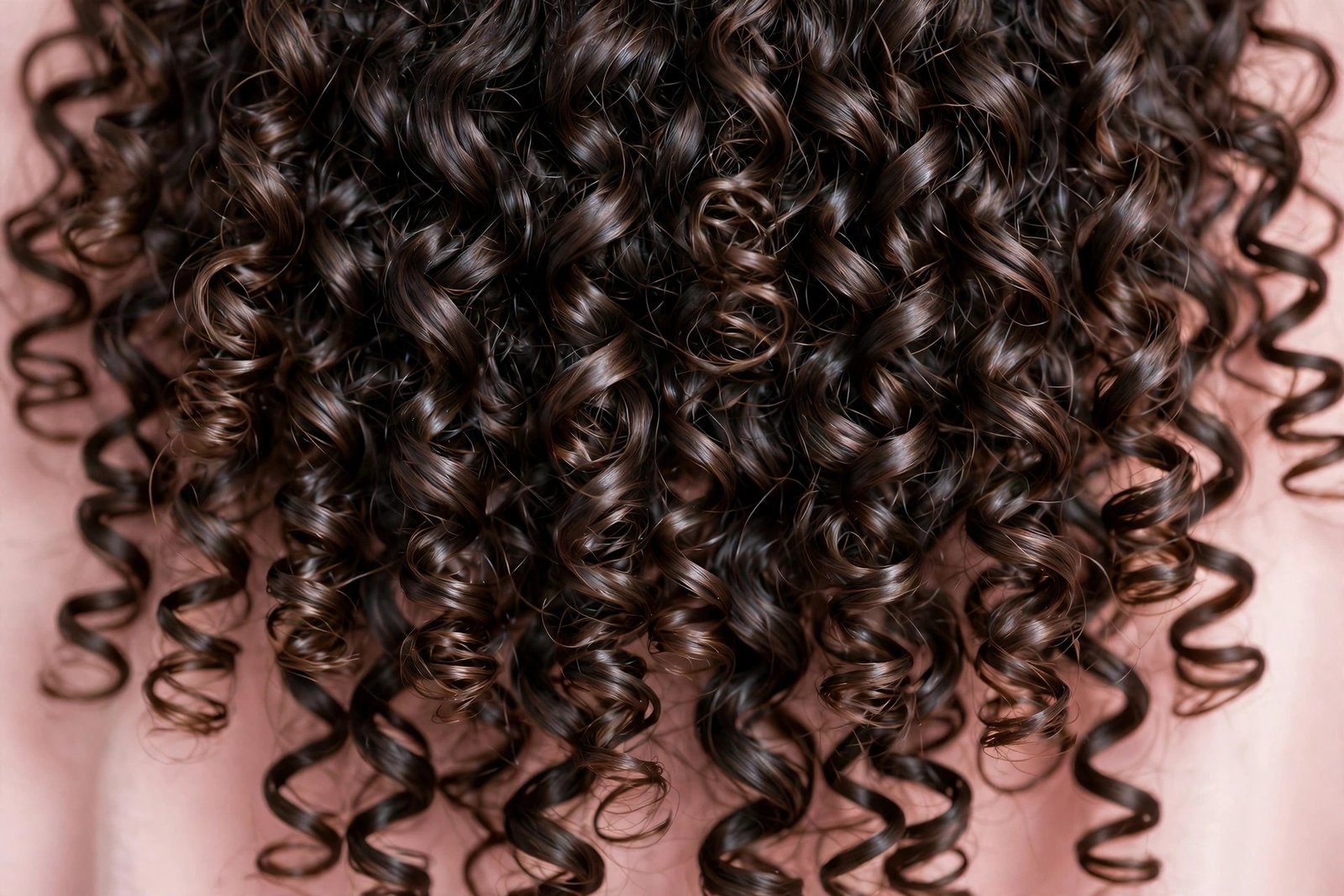
Curly Hair Frizz: A Wash-Day Routine for Defined Curls
Affiliate Disclosure: This post contains affiliate links. As an Amazon Associate I earn from qualifying purchases, at no extra cost to you. Buying through these links helps support Blushra and keeps our guides free to read. Product prices and availability can change, so please check Amazon for the latest details. See the Affiliate Disclosure page for more information.
Curly hair frizzes for a reason that has nothing to do with bad luck. A curl is a strand that bends, and every bend is a place where the surface can lift. When the surface lifts, the curl loses its shape, the strands separate from each other, and what should have been a defined curl reads as a halo instead. Straight hair can hide a rough surface. Curly hair cannot, because the curl pattern shows every break in it.
That is also why the usual frizz advice often fails on curls. Brushing it out, towel drying it hard, or letting it dry loose and untouched all work against the curl in different ways. Curly frizz is not fixed by one product. It is fixed by a wash day that protects the curl pattern from the wash itself through to the moment the hair is fully dry.
This routine is for wash day. It takes a little longer than a quick wash, but most of it is waiting time while conditioner or a mask sits, and the difference shows on the same day.
Start with wet hair, and keep it wet
The first rule of a curly wash day is that styling starts in the shower, not after it. Curly hair is at its most cooperative when it is soaking wet. The curls clump together naturally, the surface is smooth, and products spread evenly. Once hair starts to dry, that window closes, and trying to reshape it afterwards usually creates frizz instead of removing it.
So do not step out of the shower and then decide what to do with your hair. Have your leave-in or curl cream ready before you wash. Apply it while your hair is still dripping wet, or at least very damp, and work in sections so every curl gets some. If your hair has started to dry by the time you reach for a product, wet it again with your hands or a spray bottle. A curl that dries without product in it will dry in whatever shape the air gives it, and the air is rarely kind to curls.
If you are not sure whether your curls are asking for moisture or for protein, the stretch test in Protein or Moisture? How to Tell What Your Hair Actually Needs takes two minutes and points you the right way, because a curl that needs protein behaves very differently from one that needs moisture, and they need different fixes.
Wash gently, and condition like it matters
A curly wash day starts with a gentle wash. Use a moisturising shampoo, use less than you think, and keep it on the scalp. Massage with your fingertips and let the rinse clean the lengths. A strong shampoo worked through the curls strips the oils that keep the surface smooth, and stripped curls spring apart as they dry.
Conditioner is where the curl pattern is decided. Apply it generously from mid-lengths to ends, work it through with your fingers, and leave it for a few minutes. While it sits, detangle with your fingers or a wide-tooth comb, starting from the ends and working up. Detangling on dry hair breaks curls apart and creates frizz at the root of the problem, so do it here, while the hair is slippery with conditioner, and do not do it again once the hair is dry.
Rinse with lukewarm water, and leave a little conditioner in if your hair is very dry. A small amount left in the ends acts as a first layer of moisture, and curly hair usually needs that extra layer more than straight hair does. The full wash-day method, step by step, is in Why Is My Hair Frizzy After Washing? (And How to Stop It), and it is worth following closely for curls, because the wash sets up the curl for the rest of the day.
A weekly mask keeps curls from drying out
Curls lose moisture faster than straight hair, because the bends in the strand let moisture escape and make it harder for the scalp’s natural oils to travel down the length. That is why curly hair often feels dry even when it is washed carefully, and why a weekly mask matters more for curls than for most hair types.
Once a week, after shampooing, apply a mask to the lengths and ends and leave it for ten to fifteen minutes. Cover your hair with a shower cap while it sits, which keeps it warm and stops it drying out. Then rinse and condition as usual. Hair that is regularly deep conditioned holds its curl pattern longer, and the difference shows most on the second and third day after washing, when unconditioned curls usually start to loosen and frizz.
If your curls feel soft but limp and stretchy, they may have had too much moisture and not enough protein. If they feel dry and stiff and snap easily, they may need more moisture. The causes are laid out in Why Is My Hair So Dry and Frizzy? 9 Causes and What Helps, and it is worth reading before you change products, because the fix for one is the opposite of the fix for the other.
Scrunch, do not rake
How you apply styling products matters as much as which ones you use. Raking a cream or gel through curly hair with your fingers pulls the curls apart into separate strands, and separate strands dry into frizz. Scrunching does the opposite. It pushes the curls back together into clumps, and clumps dry into defined curls.
Apply your leave-in or curl cream to soaking wet hair, then scrunch it in, section by section, squeezing the hair upwards towards the scalp. You should hear a soft squelching sound, which means the hair is wet enough and the product is going in evenly. If the hair is silent, it is too dry, so wet it again. A light gel over the cream, scrunched in the same way, gives the curls a cast as they dry, a slightly stiff shell that holds the shape. That cast is supposed to be there. You break it gently once the hair is fully dry, and the curls underneath stay defined.
This is the step people rush, and it is the step that decides whether wash day works. Slow down here, work in sections, and let the curls clump before you move on.
Plopping, and why it helps
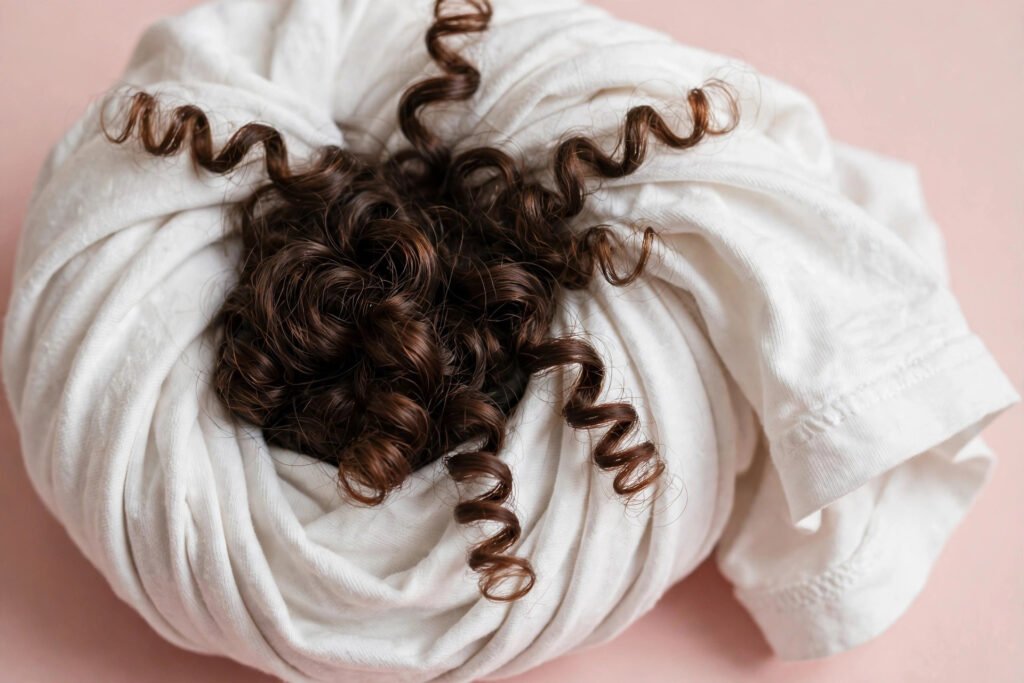
Plopping is a simple drying step, and it is one of the most useful things a curly routine can borrow. After you have applied your products, lay a soft cotton T-shirt or a microfibre towel flat, tip your head forward so your curls fall onto the centre of it, and wrap the fabric around your head, tying it at the back. Leave it for fifteen to twenty minutes.
What plopping does is remove water without disturbing the curls. A regular towel rubbed over curly hair roughens the surface and breaks the clumps apart. Plopping lifts the water away while the curls keep their shape, and it shortens the drying time that follows. It also helps the curls dry with more lift at the roots, because they are not weighed down by dripping water while they set.
Do not leave the wrap on for hours. Twenty minutes is enough to take the worst of the water out. After that, take it down and let the hair air dry, or diffuse it, without touching it again until it is fully dry.
Diffuse, or let it dry untouched
Once the hair is out of the wrap, it has two good options. Air drying works well if you have time, and it is the gentlest option. The rule is simple. Do not touch it while it dries. Every touch while curls are drying breaks the surface and separates the clumps, and the frizz you see at the end was often created by a hand checking whether the hair was dry yet.
If you use a diffuser, use it on low or medium heat, and keep it moving. Cup a section of curls into the diffuser bowl, hold it near the scalp for a few seconds, then move on. Do not blast the curls from above, which blows them apart, and do not dry them completely. Stop when the hair is about eighty percent dry, and let the rest finish on its own. Always use a heat protectant first, and point the airflow upwards into the curls rather than down onto them.
Whichever way you dry, wait until the hair is fully dry before you touch it. Then scrunch out the gel cast gently with your hands, or with a drop of oil on your palms. The curls underneath should spring back, defined and soft, instead of stiff. If you break the cast while the hair is still damp, the curls will not set properly, and the frizz will come back within the hour.
The days after wash day
A good wash day should last more than a day. On the second and third morning, do not wash again and do not brush the curls out. Instead, refresh them. Wet your hands, smooth a little water over the surface, and scrunch a small amount of leave-in or water into the curls that have loosened. A silk or satin pillowcase helps here as well, because cotton pulls moisture out of curls overnight and roughens the surface while you sleep. The overnight method is covered in full in How to Prevent Frizzy Hair Overnight and Refresh It in the Morning, and it is worth reading if your wash day looks good on day one and falls apart on day two.
If the curls still frizz badly by midday, the cause is often the air rather than the routine. Humidity pulls moisture into dry curls and swells them unevenly, and the fix is to seal the surface before you go out, as explained in How to Stop Frizzy Hair in Humidity. A thin layer of oil or leave-in over the curls, smoothed on with your palms, slows the air getting in.
What not to do with curls
A few habits undo a good curly wash day faster than any product can fix it. Do not brush curly hair when it is dry. A brush pulls every curl apart into separate strands, and the result is frizz, not smoothness. Detangle only in the shower, with conditioner in. Do not rub curly hair with a regular towel. Squeeze or plop instead. Do not use a strong shampoo through the lengths, and do not skip conditioner to save time. And do not keep touching your hair while it dries to check on it. Each of these feels small on its own, and together they are usually the reason a wash day fails.
If you change all of the above and the frizz stays exactly the same, look wider. Hard water can leave a mineral layer on curls that no amount of gentle washing removes, and that needs a clarifying wash every few weeks. The full routine, with the wash, the mask, and the weekly rhythm, is in How to Care for Dry, Frizzy Hair: A Simple Routine That Works, and it is the foundation this wash-day routine sits on.
Give the curls a few wash days
A curly routine does not prove itself on the first wash. Hair that has been brushed dry, towel dried hard, and washed with a strong shampoo for years needs a few wash days to settle into a new pattern. Follow the same steps for three or four washes, change only one thing at a time if something is not working, and judge it on how the curls look on day two, not just straight after drying. The curls will usually start to clump better by the second wash, and the frizz will shrink from there, one wash day at a time.


One Comment